Everyday Mental Wellness Made Simple with Fresh,Practical Ideas
By: Lexie DY
Busy parents juggling work and wellness, hybrid employees bouncing between meetings, and
caregivers managing nonstop notifications often hit the same wall: there’s no clear boundary
between pressure and rest. The core tension is simple and heavy, everyday stress relief gets
treated as a luxury, even while mental and emotional wellness quietly shapes focus, patience,
sleep, and relationships.
When general audience mental health advice feels vague or
unrealistic, it helps to have unique mental health strategies and wellbeing improvement
techniques that fit into real schedules and real moods. Small shifts can make the day feel more
manageable.
Try 4 Low-Barrier Ways to Calm Your Nervous System
When stress feels constant, small, safety-minded experiments can help your body downshift
without changing your whole routine.
● Breathing practices: Try slow, steady breathing to gently signal “safe” to your nervous
system.
● Mindfulness exercises: Briefly notice sensations, thoughts, or sounds without judging
or fixing them.
● Ashwagandha: Some adults consider this herbal option; start cautiously and check for
interactions.
● THCa: If you’re exploring legal hemp-derived tools, top-rated THCa cartridges can be an
optional resource to review.
Understanding Why Variety Helps Mental Wellness
Sometimes the “right” tool depends on the moment. Diverse mental wellness practices work
because your mind is not one-dimensional. A holistic approach treats wellbeing as an
interconnected system of body, emotions, relationships, and meaning. So you build a menu of
options, then choose what fits your brain, your schedule, and your stress pattern.
This matters because one technique can fail simply because it mismatches your trigger. A wider
toolkit helps you respond sooner, with less effort, and without forcing a full lifestyle overhaul.
Over time, self-care activities can soften how much stress dents your quality of life.
Think of it like packing for unpredictable weather. You might use breathwork for racing thoughts,
a short walk for restlessness, and a creative task for emotional overload. With that idea in place,
you can try nine novel activities and keep what genuinely sticks.
Choose Outside-the-Box Practices You Can Start This Week
If variety keeps your brain engaged, these practices give you more “handles” to grab when
stress shows up, some calm your body, some clear your head, and some help you process
emotions in a new way. Pick two for this week: one quick reset and one deeper practice.
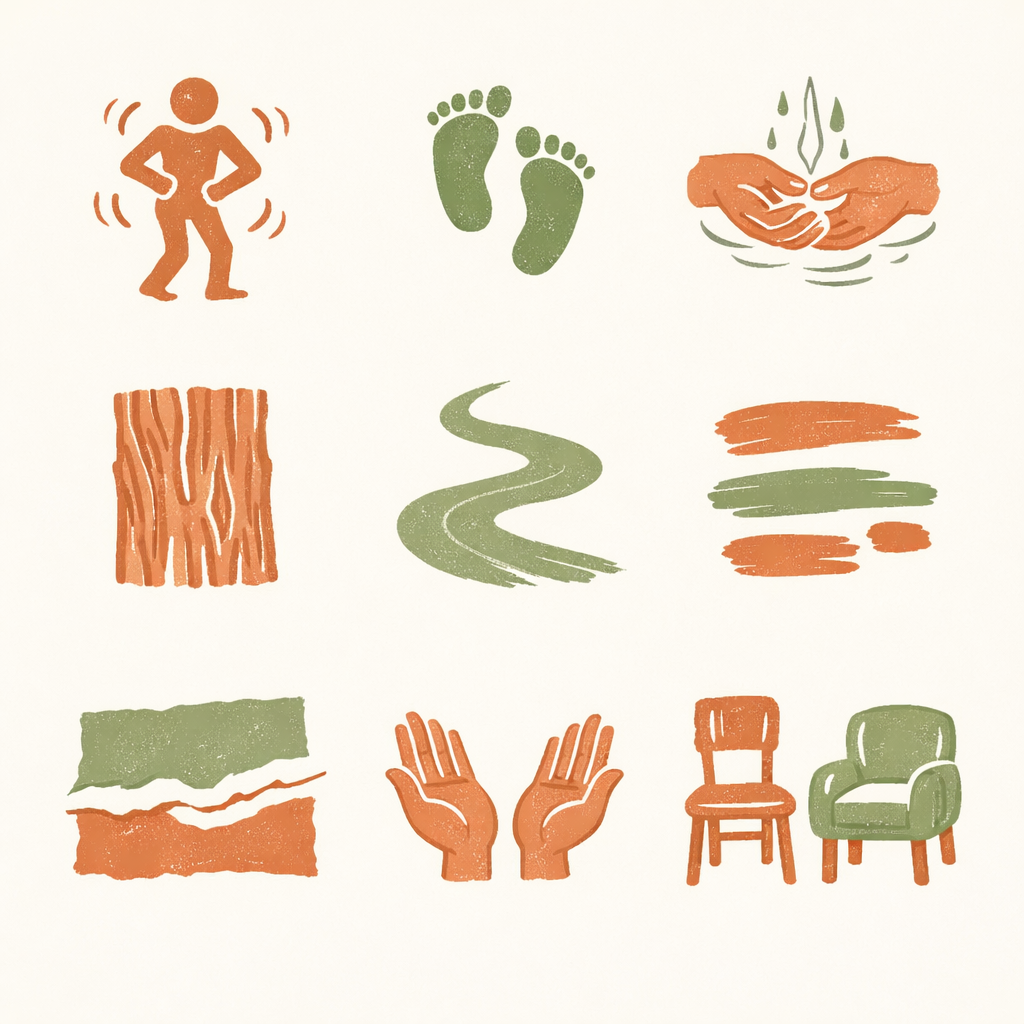
- Two-Song Shake & Settle (movement therapy light): Put on one upbeat song and
shake out your hands, shoulders, and knees for the full track, then switch to a slower
song and do long exhales while standing still. This works because it discharges tension
first, then signals safety to your nervous system. Start small: 60 seconds of shaking + 3
slow breaths. - Backward Walking “Attention Walk” (balance + brain focus): In a safe, flat space
(hallway, empty park path), walk backward for 10–20 steps while lightly turning your
head to scan left/right, then walk forward normally for 1 minute. The novelty forces
gentle concentration, which can interrupt spiraling thoughts. Setup tip: keep one hand
near a wall or railing. Start small: 3 backward steps, twice. - Box-Breath + Cold Hands Reset: Run your hands under cool water for 20–30 seconds,
then do 4 rounds of box breathing: inhale 4, hold 4, exhale 4, hold 4. The temperature
cue plus steady breathing can bring you back to the present quickly. Start small: skip
the water and just do 2 rounds of breathing. - “Three Textures” Nature Grounding (nature-based relaxation): Go outside and find
three different textures on purpose, tree bark, a smooth stone, grass, then describe each
in your head using five words. It’s a simple sensory anchor that helps your mind stop
time-traveling into worries. Start small: do it on a balcony or by an open window with a
houseplant and two household objects. - Micro-Adventure Route Swap (novelty without effort): Change one default path, take
a different street, staircase, or store aisle, and look for five things you’ve never noticed.
This uses variety strategically: you’re giving your brain a low-stakes “new input” dose
that can lift mental fatigue. Start small: pick one new turn on your usual walk. - 45-Min “Process Art” Session (art-therapy-style alternative): Set a timer for 45
minutes and make marks without a plan, scribbles, shapes, color blocks, collage, then
title the piece with a feeling word. A 45-min art session has been linked with measurable
calming in the body, and the no-rules approach reduces performance pressure. Start
small: 10 minutes, one color, one page. - Anger-to-Action Paper Ritual (creative stress management): Write one page starting
with “I’m angry that…” then tear it up and write one tiny action you can do in 5 minutes
(send a message, tidy one surface, book an appointment). You’re translating emotion
into direction, which can reduce stuckness. Start small: write three bullet points, not a
page. - Somatic “Boundary Practice” (movement + self-trust): Stand with feet grounded,
press your palms forward at chest height, and say (out loud if you can) “Not today” on a
long exhale, 5 times. This pairs a clear physical gesture with language, which can help
your body believe your boundary. Start small: do it silently once before you answer a
stressful email. - Two-Chair Decision Check (values clarity practice): Place two chairs facing each
other; sit in Chair A as “Current You” and state the problem in one sentence, then move
to Chair B as “Future You” and answer: “What matters here?” and “What’s the smallest
next step?” This builds the variety habit of switching perspectives when you’re stuck.
Start small: write the two answers without moving seats.
Link Wellbeing to Work: Build Purpose with One Practical Path
Pursuing a meaningful career path can support everyday mental and emotional wellness
because it gives your days direction: setting professional goals creates something tangible to
aim for, learning new skills builds confidence through steady progress, and working toward a
rewarding role can reinforce a sense of purpose and personal growth. If you’re drawn to
healthcare, flexible educational opportunities may make that next step feel more doable,
especially when you’re balancing work, family, or other responsibilities.
For example, prelicensure nursing bachelor’s programs typically combine academic coursework
with hands-on clinical training, preparing you to provide direct patient care across a range of
healthcare settings. If you’re exploring that option, details on a prelicensure RN pathway can be
another piece of the puzzle as you think through what aligned work could look like for you.
Everyday Mental Wellness: Quick Questions Answered
Q: What if I only have five minutes a day?
A: Five minutes is enough to run a tiny experiment. Pick one action you can finish in that
window, like stepping outside for daylight, doing ten slow breaths, or writing one sentence about
what you need. Keep it the same for three days so you can notice a real pattern.
Q: How do I keep this from becoming expensive?
A: Start with free or already available options: walking, stretching, a library book, a phone timer,
or a quick check-in with a trusted person. If you do spend, cap it with a simple rule like “one
small tool under $15, then reassess.” Consistency beats buying the perfect solution.
Q: Why should I bother if I’m not “that bad”?
A: Small support now can prevent bigger strain later, and the financial costs of poor mental
health show how much wellbeing affects daily functioning. Think of it like brushing your teeth,
not a crisis response. Choose one habit that makes tomorrow easier.
Q: How do I stay motivated when I’m tired or overwhelmed?
A: Don’t rely on motivation; rely on friction-reduction. Put the habit where it happens, like a
water bottle by the bed or a note on your laptop, and tie it to an existing routine. Aim for
“minimum viable self-care,” then stop.
Q: Can these simple ideas actually help, or is it placebo?
A: Even if the first change feels small, tracking one signal makes it real: sleep quality, irritability,
focus, or how quickly you recover from stress. Try one idea for a week, then keep only what
noticeably helps. If nothing shifts, that is useful data, not failure.
Understanding Safe Self-Care Experiments
A simple way to build mental wellness is to treat self-care like a safe experiment, not a
personality test. Set one tiny goal, pick a comfort level that feels doable, and track one signal so
you can tell if it helps.
This matters because real life has limits: money, time, energy, and access. With so many
options, including a growing self-care apps market, a small test keeps you from chasing trends
and burning out.
For example, if afternoons feel tense, your goal might be a two-minute reset after lunch. Choose
a comfort level, like a short walk in the hall instead of a full workout, and track one signal such
as how quickly your body relaxes. That approach turns diverse ideas into steady habits, so you
can pick one practice to try for three days.
Make One Small Shift for Stronger Everyday Mental Wellness
When life is busy or unpredictable, mental wellness can start to feel like one more thing to
manage instead of support. The steadier path is a safe self-care experiment mindset: keep it
small, choose a comfort level, and track one simple signal so embracing diverse wellness stays
realistic.
Over time, those small tests become daily emotional wellbeing habits that feel natural,
giving you inspiration for mental wellness that fits your actual days and supports long-term
mental health strategies. Small, repeatable practices build the strongest sustainable self-care
approaches. Pick one practice to try for three days and note what changes in your mood,
energy, or patience. That’s how stability and resilience grow, quietly, through choices you can keep.
Special thanks to my guest writer, Lexie Dy! Lexie is a freelance writer who covers personal growth, wellness, and everyday strategies for living a more intentional life. I loved Lexie’s fresh take on nervous system resets and wanted to share her perspective with you. The views and product references in this post are her own.