Future-Proof Your Mind with Simple Steps for Lasting Resilience

By: Lexie Dy
Busy parents juggling work and caregiving, early-career professionals facing role changes, and community leaders responding to constant disruption all share the same challenge: an uncertain world keeps moving the goalposts.
Uncertain world challenges like sudden layoffs, health scares, political tension, and nonstop information can make even capable people feel reactive and depleted. Mental resilience in uncertainty isn’t about staying calm all the time; it’s the capacity to recover, think clearly, and keep choosing what matters for lasting resilience under pressure.
By future-proofing the mind, building psychological adaptability for changing conditions, general readers navigating change can stay steady when life shifts.
Understanding the Building Blocks of Resilience

Mental resilience is the ability to bounce back from adversities, but it is not one trait you either have or lack. It is a set of trainable frameworks: openness to change, curiosity, lifelong learning, mindfulness, emotional agility, supportive relationships, and realistic optimism.
These frameworks matter because they turn pressure into choices. Work becomes less draining, conversations get less reactive, and setbacks stop defining your next week. Over time, resilience can buffer the negative effects of stress and burnout, supporting job satisfaction and engagement, which changes how you show up at home and at work.
Think of them like a mental toolkit. Mindfulness helps you notice stress early, emotional agility helps you name it without spiraling, and realistic optimism helps you plan without denial. Supportive relationships act like a backup battery when your own capacity runs low. With these pieces clear, career uncertainty becomes a practical place to train them.
Use Career Change to Train Adaptability (Without Burning Out)
Resilience becomes real when you practice it in high-stakes, everyday uncertainty, like your career. A career change can be a powerful workout for adaptability: it asks you to tolerate ambiguity, stay open to unexpected opportunities, and keep learning even when you don’t have all the answers. Instead of treating a transition as proof that something went wrong, you can frame it as evidence that you’re capable of recalibrating, updating your skills, testing new directions, and rebuilding confidence through action.
That mindset matters because workforce shifts aren’t happening in a vacuum. Studies show that as burnout and dissatisfaction rise, many employers are prioritizing external hiring over developing the people they already have, widening skills gaps and narrowing growth pathways for both workers and organizations. In that environment, understanding barriers and trends can help you make calmer, more informed choices; you can learn more here about workforce insights that connect the dots between hiring patterns, skill needs, and career mobility.
Daily Resilience Habits for Uncertain Seasons
Big changes feel less threatening when you train your nervous system and mindset in tiny reps. These habits build mental resilience by turning uncertainty into something you can notice, name, and respond to consistently over time.
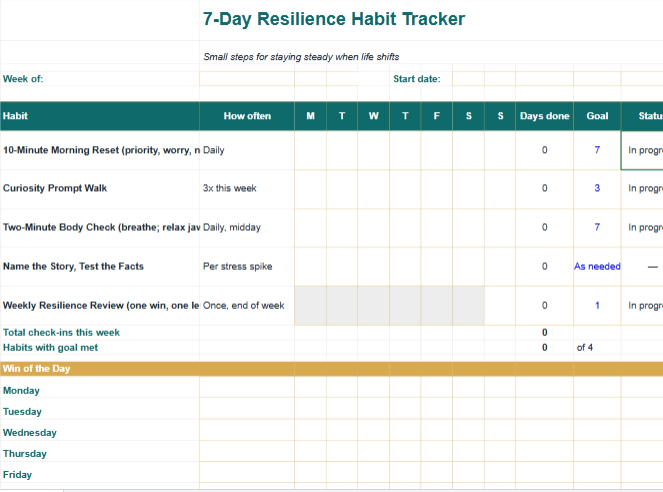
10-Minute Morning Reset
- What it is: Write your top priority, one worry, and one next step.
- How often: Daily
- Why it helps: It converts vague stress into clear, doable action.
Curiosity Prompt Walk
- What it is: Take a short walk and seek new information about what you notice.
- How often: 3 times weekly
- Why it helps: Curiosity widens options when outcomes feel narrow.
Two-Minute Body Check
- What it is: Pause, breathe slowly, and relax your jaw, shoulders, and hands.
- How often: Daily, midday
- Why it helps: It downshifts reactivity so you can choose your response.
Name the Story, Test the Facts
- What it is: Separate facts from your interpretation, then list two alternative explanations.
- How often: Per stress spike
- Why it helps: It interrupts fixed mindset thinking and restores flexibility.
Weekly Resilience Review
- What it is: Note one win, one lesson, and one adjustment for next week.
- How often: Weekly
- Why it helps: Small course-corrections build confidence without perfectionism.
Mental Resilience Questions People Ask Most
Q: What does “mental resilience” actually mean in daily life?
A: It is the ability to respond well when life throws curveballs, even if you still feel stressed. In practice, it looks like pausing before reacting, choosing one helpful next step, and recovering faster after a hard day.
Q: How do I stay steady when the future feels genuinely uncertain?
A: Focus on what is controllable in the next 24 hours: your sleep window, one priority, and one conversation you are avoiding. Keep a short list of “if-then” plans so you are not decision-making while flooded.
Q: Should I push through discomfort, or is that risky?
A: Use the “safe stretch” rule: a practice should feel challenging but not overwhelming. If you notice panic, shut down, or insomnia worsening, scale down the habit and choose a gentler version.
Q: When is it better to talk to someone instead of handling it alone?
A: Choose support when thoughts loop, you feel isolated, or you cannot take basic steps. Often talking about our concerns with someone you trust turns a foggy fear into a clearer plan.
Q: Can small habits really make a difference if my stress is big?
A: Yes, because repetition trains your response over time. Start with one tiny practice for seven days, track what changes, and adjust instead of quitting.
Sustain Mental Resilience Through One Week of Small Practice
Uncertainty still shows up without warning, and that can make even strong plans feel fragile. The way through is a steady approach: sustaining mental resilience by practicing adaptability and keeping a realistic commitment to growth, especially when progress feels slow. Over time, long-term mindset development shifts challenges from personal threats into solvable situations, and your confidence becomes less dependent on perfect conditions. Resilience is built in small repeats, not big breakthroughs.
Want to put these habits into practice? Download the free 7-Day Resilience Habit Tracker.
Special thanks to my guest writer, Lexie Dy! Lexie is a freelance writer who covers personal growth, wellness, and everyday strategies for living a more intentional life. I loved Lexie’s practical, steady approach to building mental resilience, which turns uncertainty into small, manageable choices and anchors them with simple daily habits anyone can start this week. The views expressed in this post are her own.



Post Comment